When the first images and trailers for Christopher Nolan’s The Odyssey began circulating, the costumes quickly became one of the film’s most debated elements.
Viewers expected an epic based on Homer’s world, but what they saw was not quite the familiar “sword-and-sandals” version of Greece.
Instead, the film presented weathered bronze, dark armor, unusual silhouettes, elaborate royal clothing, and designs that sometimes looked closer to fantasy or modern cinematic armor than conventional depictions of the Bronze Age.
The criticism was not entirely about whether the costumes looked appealing. Much of it concerned historical accuracy. If The Odyssey takes place around the world of the Trojan War, shouldn’t its warriors look more recognizably Mycenaean?
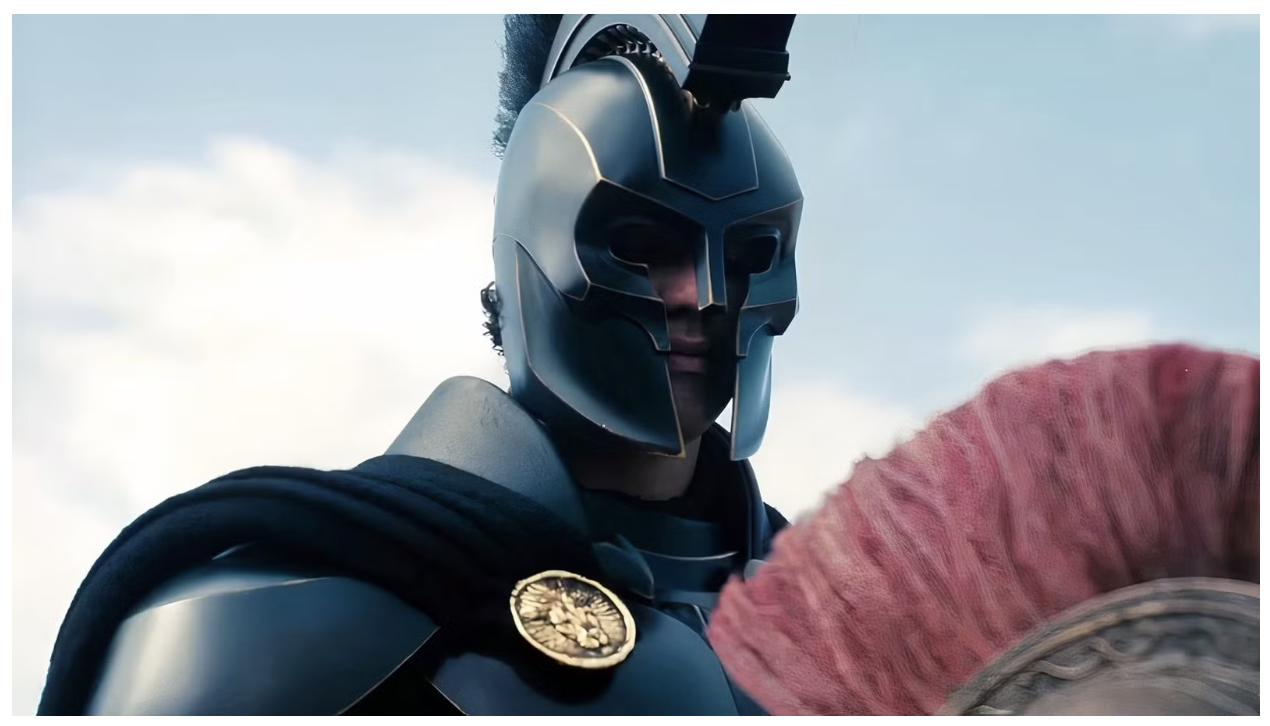
Agamemnon’s “Batman” Armor
You have to admit it. It does look cool, though.
The most immediate controversy centered on Agamemnon, played by Benny Safdie. His dark, highly stylized armor drew comparisons to Batman’s suit, particularly because of its black finish, angular construction, and imposing silhouette.
Some viewers found the design to be a significant departure from their expectations of Bronze Age armor.
The criticism had some historical substance, although it was frequently overstated. Christopher Nolan later explained that the production had researched blackened bronze and that surviving Mycenaean objects demonstrate that dark bronze was possible.
The problem, therefore, was not simply that the armor was black. Rather, critics questioned whether the specific design had any archaeological precedent.
The production also had a narrative reason for making Agamemnon visually distinctive. His armor was intended to communicate exceptional wealth and status, using expensive materials and a silhouette that separated him from ordinary soldiers.
The spine, for example, is meant to convey that without this domineering armor, Agamemnon is lacking one, connoting that he is a soldier only in appearance.
That is a defensible artistic choice, but it is different from claiming that the costume represents historically reconstructed Mycenaean armor.
Odysseus and the Missing Boar-Tusk Helmet
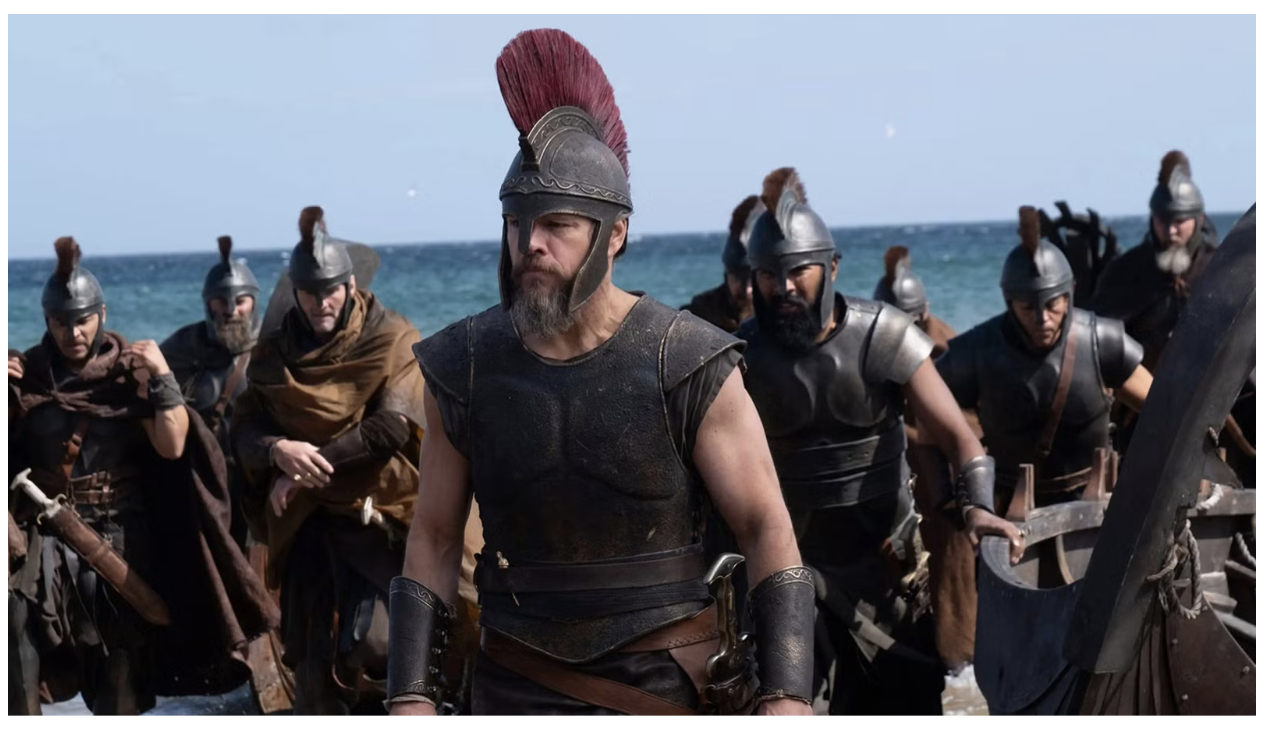
Odysseus generated another, more specific historical objection.
Matt Damon’s character appears in a relatively streamlined warrior costume, complete with a conventional-looking helmet. For viewers familiar with Homeric warfare, this detail immediately raised a question: where is Odysseus’s boar-tusk helmet?
The detail matters because Homer specifically describes Odysseus wearing one, and archaeologists have found actual Mycenaean helmets made from boar tusks.
The text supports the criticism and is considerably more concrete than simply complaining that a costume “doesn’t look Greek.”
The issue illustrates the larger tension surrounding the film. Nolan’s production researched the Bronze Age extensively, but it did not intend to reproduce every detail of Homeric material culture literally.
Costume designer Ellen Mirojnick has explained that the objective was a “timeless period,” rather than a reconstruction of one precise historical era.
The Problem of the “Generic Greek” Look
Another recurring complaint was that some costumes appeared to represent generic Hollywood Greece rather than the Late Bronze Age specifically.
Much of the visual language audiences associate with ancient Greece actually comes from the Classical period, which occurred much later, centuries after the traditional setting of the Trojan War.
A costume can therefore look perfectly “Greek” to a modern viewer while still being inappropriate for the world of Mycenaean Greece.
Some of The Odyssey‘s costumes invited precisely this criticism. Others went in the opposite direction, incorporating designs that seemed medieval, Renaissance-inspired, or deliberately fantastical.
Telemachus’s more princely costumes, for example, prompted comparisons to later European court fashion rather than Bronze Age royalty.
There were also complaints about trousers and other garments that seemed culturally out of place.
These criticisms become complicated because ancient Mediterranean clothing was not static, and the Homeric poems themselves contain material from different historical periods.
Was Historical Accuracy Even the Goal?
Mirojnick has been unusually clear about the production’s philosophy.
She and Nolan researched Mycenaean Greece, Late Bronze Age Mediterranean cultures, ancient textiles, frescoes, weaving, seafaring traditions, and archaeological material.
More than 5,300 costumes were reportedly created. Yet the objective was not to reconstruct a museum exhibit.
Instead, the costumes were designed to make Homer’s world feel ancient while remaining emotionally legible to a modern audience.
They were not looking at strict archaeological reconstruction. They were looking at Nolan’s interpretation of Homeric mythology.
In that sense, the costumes are closer to the visual logic of something like a GG Perya game: recognizable ideas are taken from a traditional setting, then rearranged into a distinct visual identity.
The Bigger Historical Problem
There is also a fundamental complication with demanding perfect historical accuracy from The Odyssey: Homer’s own world is not historically consistent.
The poems were transmitted through oral tradition and contain elements associated with different periods. Some details correspond to the Bronze Age, while others reflect the society that existed centuries later.
Not every costume choice is historically accurate. It simply means that there is no consistent historical wardrobe that Nolan could have copied.
Claims that the film is simply “historically inaccurate” are less useful because they ignore the production’s stated goal.
Ultimately, The Odyssey‘s costumes occupy a space between history and mythology. They borrow from Bronze Age evidence without being bound by it.